
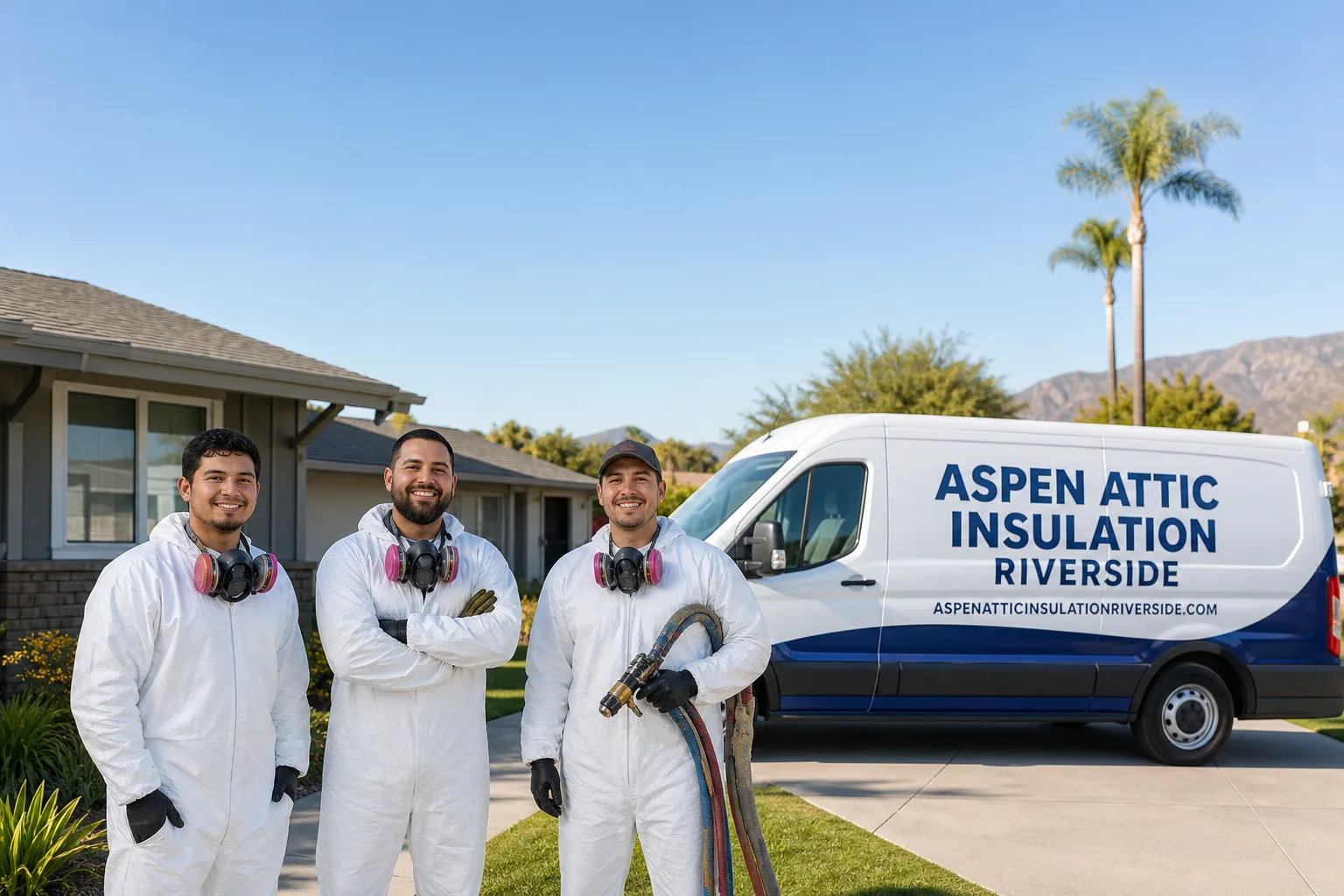
Fast, Reliable Attic Insulation Across Lake Arrowhead
Attic insulation in Lake Arrowhead has to do something most insulation jobs never ask of it: handle snow measured in feet, overnight lows near 15°F, and summers that still climb into the 80s. A home here doesn’t need one season of protection. It needs year-round thermal balance, and that means R-38 to R-60 in the attic, not the R-11 many of these older cabins are still packing. If your heating bill is climbing past $600 and your upstairs feels drafty in February, the attic is usually where the heat is going. Call us at (510) 896-3857 and we’ll schedule a look.
Why Aspen Attic Insulation Riverside Is Lake Arrowhead’s Preferred Attic Insulation Company
We work in Lake Arrowhead constantly because the mountain presents specific problems: ice dams, frozen pipes, attic condensation, and legacy insulation that has collapsed under decades of snow load. Our crews know the difference between a Cedar Glen A-frame and a Lake Arrowhead Village chalet, and we plan the job accordingly. The houses up here aren’t tract homes from the 2000s. They’re 1920s cabins and 1950s vacation places that were never designed for year-round living. We account for that.
Before any work begins, you receive a written price. Not an estimate range, not a verbal ballpark: a fixed number on a page. The technician’s name and photo are sent to you before the visit. If the person at your door doesn’t match, walk away. That’s the Threshold Standard: every technician background-checked, identity-verified, badged, uniformed. Garrett Sloane, who leads our team, won’t put a name on a work order he wouldn’t send to his own family. Founded in 2002, we’re part of the Threshold Group family, and every job carries a written 365-Day Done Right Promise covering labor and materials. If it fails within a year, we return and fix it. Free.
As our Attic Insulation in Lake Arrowhead customers will tell you, the phone gets answered by a live person. Day or night. No voicemail loops.
Attic Insulation Removal in Lake Arrowhead
Attic Insulation Removal in Lake Arrowhead is the first step for dozens of cabins we’ve worked on in neighborhoods like Cedar Glen, Skyforest, and the area near Grass Valley Road. The old fiberglass batts in these homes have slumped, compressed, and absorbed decades of moisture from freeze-thaw cycles. Pulling them out is the only way to inspect the attic floor, air-seal the gaps, and start fresh. A removal job here runs $1,200 – $2,800, depending on attic size and how much material has degraded. Most jobs take one day, sometimes two for larger places with knee-wall cavities.
When Your Old Batts Have Got to Go
Homeowners ask if they can just blow new insulation over the top of old batts. Sometimes, yes. But when the original insulation has compressed to under 2 inches under snow load, it isn’t insulating anything, and the air leaks beneath it are still moving heat straight through the ceiling. You’re paying to heat the roof. Removal also lets us check for rodent damage, old knob-and-tube wiring, and moisture stains on the sheathing.
Air-Sealing Before the New Insulation
Removal alone doesn’t fix much. The real gain comes from sealing the attic floor: can lights, plumbing penetrations, top plates, and the gaps around the chimney chase. In Lake Arrowhead, where warm interior air pushes into cold attic spaces all winter, air-sealing is the difference between a warm home and an ice dam forming at the eaves. We do both, and we price the full job in writing before the first bag of old insulation comes down.
Insulation Contractors in Lake Arrowhead
Insulation Contractors in Lake Arrowhead have to understand mountain framing, not just attic floors. Sloped ceilings, cathedral spans, knee-walls, and crawlspaces on the downhill side of the lot are standard here. We’ve done A-frames where the entire attic is actually the living space, and the only accessible cavity is a 3-foot crawl. Different structures, different approach, different material. You can’t treat a 1960s chalet off of Highway 173 the same as a ranch in the flatlands. We don’t try to.
Attic Baffles and Ventilation Prep
Before new insulation goes in, the attic needs to breathe. Blocked or missing baffles trap moisture against the roof sheathing, and in Lake Arrowhead’s freeze-thaw cycle, that trapped moisture freezes, thaws, and re-freezes all winter long. Over a few seasons, sheathing rots and mold takes hold. We install the right baffles to keep airflow moving from the soffits to the ridge, and we verify the existing vents actually work before the insulation is placed.
Attic Insulation Top-Up Where It Makes Sense
Not every attic needs a full gut. Some homes built in the 1990s and 2000s have decent batts that simply aren’t deep enough for the mountain’s temperature swings. If the existing material is sound, a top-up of blown-in insulation can bring an R-19 attic up to R-49 for $900 – $1,700. It’s the right move when the insulation is recent and the air-sealing is already intact.
Trusted Brands We Service in Lake Arrowhead
Our Attic Insulation team carries materials from GreenFiber, Owens Corning, and Johns Manville, matched to the specific job. For Lake Arrowhead attics, we often recommend GreenFiber cellulose for its dense-pack performance in odd-shaped cavities and its ability to slow air movement. Owens Corning fiberglass batts work well in standard joist bays. Johns Manville is our go-to for the occasional formaldehyde-free request. We carry enough material to serve every Lake Arrowhead zip code from 92352 down to the Blue Jay area, so a materials shortage is never the reason your job gets delayed.
Common Attic Insulation Problems We See in Lake Arrowhead Homes
- Slumped fiberglass batts from snow load. Decades of winter after winter pressing down on a roof compresses the insulation underneath. We’ve measured original batts at under 2 inches, effectively R-11 in a climate that needs R-49. The fix is removal and replacement, not a top-up.
- Ice dams at the eaves. When heat leaks through an under-insulated attic, it melts the snow on the roof. The melt runs toward the cold eave, refreezes, and water backs up under the shingles. The symptom is icicles and water stains on interior ceilings. The cause is almost always attic heat loss.
- Frozen pipes in the crawlspace and knee-walls. Settled insulation below R-19 leaves cold spots along sloped ceilings and open crawlspaces on the downhill side. Pipes freeze, burst, and the repair bill dwarfs what an insulation job would have cost.
- Mold on the roof sheathing. When ventilation is blocked and warm air rises into the attic, condensation forms on the underside of the roof deck. Lake Arrowhead’s frequent freeze-thaw cycles make this worse, cycling moisture into the wood over and over. By spring, the sheathing is stained and soft.
Pricing for Attic Insulation in Lake Arrowhead, CA
What you’ll pay depends mostly on what’s up there now. Attic insulation removal in Lake Arrowhead runs $1,200 – $2,800. A full removal plus air-sealing plus new blown-in insulation to R-49 typically lands between $3,500 – $7,800 for a standard 1,200 – 2,200 square foot cabin. A top-up over existing sound insulation is the cheapest route at $900 – $1,700. Attic baffle and ventilation prep adds $300 – $900 depending on the number of rafter bays. Every quote is written, itemized, and delivered before work starts. No post-job surprises. Call (510) 896-3857 for your exact number.
We Also Serve Cities Near Lake Arrowhead
Our crews also cover the surrounding mountain and foothill communities. You’ll find us working in Highland, San Bernardino, Mentone, and Rialto, where the housing stock changes from mountain cabins to mid-century ranches but the insulation problems follow a similar pattern: old batts, air leaks, and utility bills that could be $30 – 40 lower every month. Dispatch and scheduling for the Lake Arrowhead area are coordinated from our Inland Empire office, and crews are on the mountain multiple days a week.
Serving Lake Arrowhead, CA - Our Local Coverage Area
We’re based in the Lake Arrowhead area and know this community well. Use the map below to see our service coverage - if you’re nearby, we can almost certainly help.
FAQs About Attic Insulation in Lake Arrowhead
Because the temperature difference between the living space and the outside is far greater up here. San Bernardino can get by with R-30 in the attic because winter lows hover around 40°F. Lake Arrowhead regularly drops below 20°F and stays there for weeks. The Department of Energy’s climate zone map puts the mountain at R-49 to R-60, which is roughly double the flatland requirement. Call (510) 896-3857 and we’ll tell you exactly what your attic is currently rated.
Only if the old batts are dry, intact, and at least somewhat effective. In most 1950s Lake Arrowhead cabins, the original insulation has compressed to the point where it isn’t doing anything, and it’s trapping moisture against the attic floor. Adding new insulation on top locks in the problem and masks the air leaks beneath. We inspect first, and if removal is the right call, we’ll say so. You’ll get the written price either way.
Ice dams form when heat from the living space escapes into the attic, warms the roof deck, and melts the snow from underneath. The melt runs to the cold eave and refreezes. Good attic insulation with proper air-sealing stops the heat from reaching the roof deck in the first place, so the snow stays frozen and melts evenly from the top down. In A-frames and chalets, where the roofline is steep and dramatic, this is the single most effective fix for ice dams. Call us for an evaluation before the next snow season.
Because the crawlspace is a separate thermal zone. Many Lake Arrowhead homes sit on sloping lots, leaving a crawlspace open on the downhill side. Cold air moves through it freely, and if the floor above is insulated with old, settled material below R-19, the cold reaches pipes in short order. The fix is insulating and air-sealing the crawlspace band joists, not just the attic. We’ll assess both spaces and quote the job as one package.
In most pre-1980 homes, yes. You can’t air-seal a subfloor you can’t see. The old insulation, especially if it’s fiberglass batts that have compressed, has to come out so we can seal the top plates, wire penetrations, and plumbing chases underneath. In newer homes with clean, uncompressed insulation, we can often pull back sections, seal, and reinstall. We’ll make that call after one look in the attic.
Written by Garrett Sloane, Owner at Aspen Attic Insulation Riverside, serving Lake Arrowhead since 2002.