
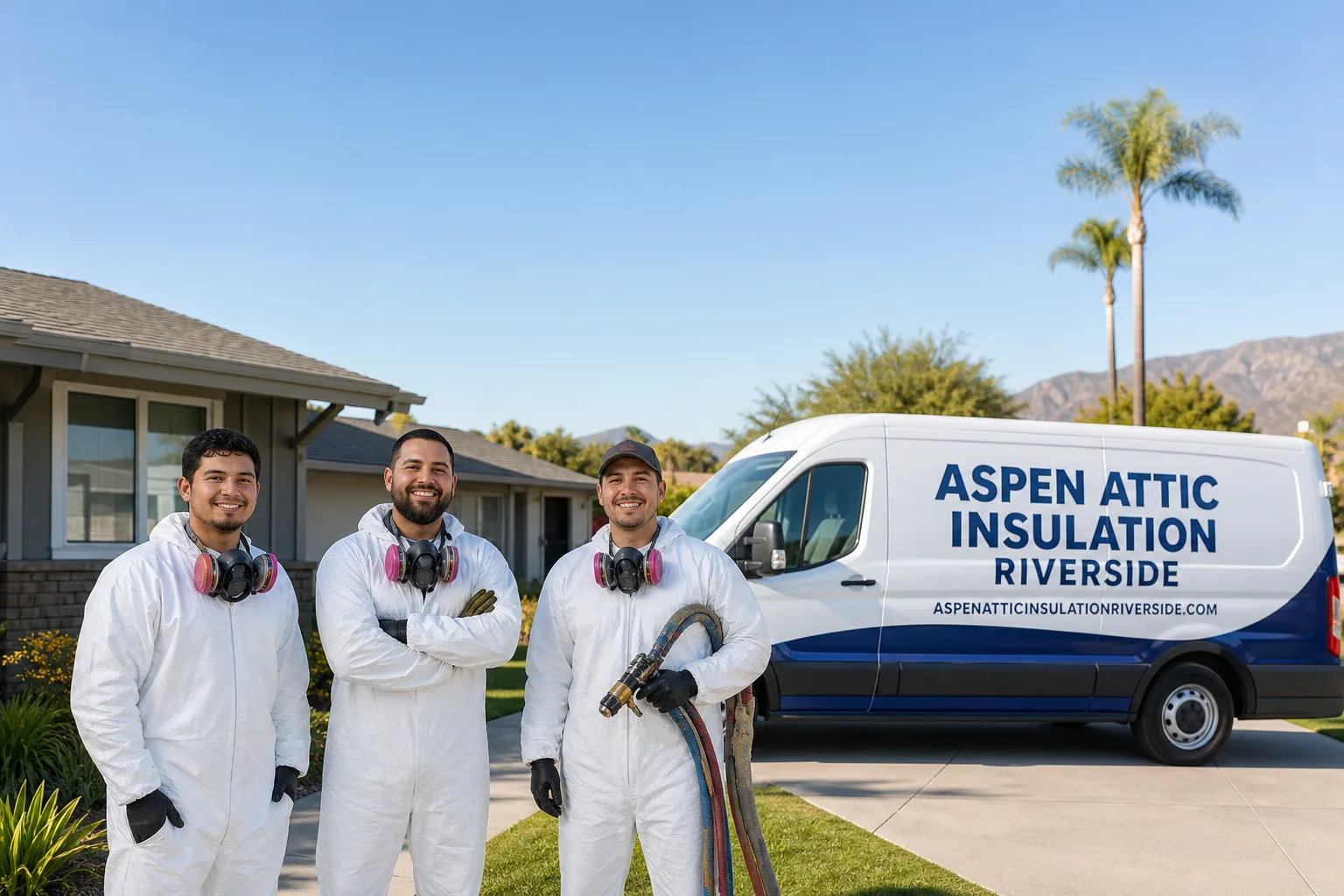
Fast, Reliable Attic Insulation Across Moreno Valley
Attic insulation in Moreno Valley is about heat. Real heat, the kind that hits 100°F in June and parks there through September. If your home was built between 1980 and 2010, there’s a strong chance the insulation above your ceiling has settled, thinned out, or simply given up. That’s why we dispatch crews into Moreno Valley neighborhoods every week: to remove the old, failed material and install insulation that actually holds its R-value when the sun beats down on your roof. A written price before any work starts, and a live person answers when you call (510) 896-3857. That’s how we do it.
Why Aspen Attic Insulation Riverside Is Moreno Valley’s Preferred Attic Insulation Company
Moreno Valley has over 4,000 single-family homes built in the 1980s and early 1990s. Most of them still have their original attic insulation. We’ve been through enough of those attics to know what we’ll find before we climb the ladder: fiberglass batts that were once 11 inches thick, now slumped to six or less. That’s not a guess, it’s a pattern. Homeowners across Moreno Valley call us because our techs show up with a name and photo sent in advance, a visible ID badge, and a clean marked uniform. Garrett Sloane set that standard, and every crew member follows it. No mystery contractor knocking at your door. The person you approved is the person who arrives.
Our Attic Insulation team works in Moreno Valley daily. We know the difference between a house off Ironwood Avenue near Box Springs Mountain and one in the newer tracts off Moreno Beach Drive. Older homes need removal first. Newer ones sometimes just need a top-up. Both get a written quote before any material gets loaded into the truck. And every job carries the 365-Day Done Right Promise: if it fails within a year, we come back free and make it right, in writing.
When Moreno Valley homeowners call, they talk to a person. Not a phone tree, not a callback window. Twenty-four hours a day, seven days a week, someone picks up. For an attic insulation company, that matters. Heat doesn’t wait for Monday morning.
Attic Mold Removal in Moreno Valley
Attic mold removal in Moreno Valley happens more often than most people expect, and it rarely comes from what you’d think. The culprit is usually the large temperature swing between Moreno Valley’s hot days and cool nights, which pulls moisture into ventilated attics along Box Springs Mountain’s foothills. The first sentence a homeowner says to us is usually the same: “I didn’t even know I had mold up there.” Mold removal in an attic means pulling out the affected insulation, treating the sheathing, improving airflow, and installing fresh material. A typical attic mold removal job in Moreno Valley runs $1,900 to $4,200 depending on the square footage and how far the mold has spread.
Where Moreno Valley Mold Hides
Mold takes hold along north-facing eaves first, where cooler surfaces hold condensation longer. We also find it in attics with boxed-in vents or bathroom fans that terminate inside the attic instead of through the roof. If you smell something musty only on certain days, or you see dark staining on roof decking from the access hatch, that’s the signal to act. Left alone, it spreads slowly, quietly, and it never gets better on its own.
What Removal Actually Involves
We pull the contaminated insulation by hand and with a commercial vacuum, then inspect the sheathing. In most Moreno Valley homes, surface-sanding and an antimicrobial treatment solve the problem. In severe cases, where dry rot has set in, a section of decking may need replacing. Once the attic is dry and treated, we air-seal the top plates and blow in new insulation. Every step covered by a written price before we start.
Attic Insulation Removal in Moreno Valley
Attic insulation removal in Moreno Valley is something we handle every week, and it’s the step most insulation companies skip. Old fiberglass batts from the 1980s and 1990s don’t just underperform; they get in the way. You can’t simply blow new insulation over something that’s already failed. You’re not solving the problem, you’re burying it. Full removal of old attic insulation in Moreno Valley typically costs $1,200 to $2,800 for a standard single-family home, with the final number driven by attic height, access, and whether the old material was batt, blown-in, or a mix of both.
Why Removal Comes First
In Moreno Valley’s tract homes, removal matters for three reasons. First, settled batts are heavy and compressed; they’re not doing their job, so leaving them under new insulation just adds dead weight. Second, you can’t air-seal the ceiling plane with old insulation in the way, and air sealing is where the real energy savings live. Third, if there’s any history of roof leaks, rodents, or mold, that old material is carrying contaminants. You want it gone, not entombed. On the east side near Box Springs Mountain, we regularly find the original R-19 batts have settled to under R-11. Removal isn’t optional there. It’s step one.
Removal First, Then What
Once the attic is clean, we air-seal the top plates and any penetrations, install baffles or verify existing ventilation, and then blow in the right R-value for Moreno Valley’s climate. For most homes that means R-38 to R-49, depending on the attic framing. We carry GreenFiber cellulose, Owens Corning, and Johns Manville products on our trucks, so the material hits your attic the same day, not two weeks later.
Trusted Brands We Service in Moreno Valley
We stock materials from eight different manufacturers and choose the right one for the job instead of pushing whatever’s on sale. For Moreno Valley’s arid heat, that usually means GreenFiber cellulose, which settles less and holds R-value better than 1980s-era fiberglass. Owens Corning and Johns Manville fiberglass can work well in tighter attic cavities where cellulose’s density would be a problem. The point is you get the product that matches your attic, your roof, and your budget. Local parts and materials are ready for same-week installs across Moreno Valley.
Common Attic Insulation Problems We See in Moreno Valley Homes
- Settled fiberglass batts from the 1980s and 1990s. Original R-19 batts in Moreno Valley’s early tract homes were rated 11 inches thick. After decades of 100°F-plus heat, many have compressed to under six inches, cutting effective R-value by more than half.
- Thermal stripes from packed-down blown-in cellulose. Arid air and big temperature swings cause blow-in cellulose to pack down in vented attics, especially along north-facing eaves. On infrared scans, those packed-down sections show up as stripes where heat pours through.
- Baked insulation under original composition shingle roofs. Early Moreno Valley tract homes with original shingle roofs absorb enormous radiated heat. That heat bakes the binder out of 1980s batt products, leaving them crumbly and ineffective.
- Attic mold from diurnal moisture swings. Moreno Valley’s cool nights pull moisture into attics that didn’t exist when the house was built. North-facing eaves and bathroom fans that vent into the attic are the two most common places we find it.
Pricing for Attic Insulation in Moreno Valley, CA
Here’s what you can expect to pay in Moreno Valley, and we don’t hide behind “it depends.” A blown-in insulation top-up over an existing attic with acceptable but thinning material runs $1,600 to $2,400 for a 1,200-square-foot attic. Full removal and replacement with R-38 cellulose runs $3,200 to $5,800. Attic mold removal, including treatment and new insulation, runs $1,900 to $4,200. Batt insulation replacement, where we remove old batts and install new ones to R-38 or R-49, runs $2,800 to $4,900. The variables are attic size, access difficulty, and whether mold or pests are involved. Every quote is written, signed, and yours to keep before work begins. Call (510) 896-3857 and you’ll have a number in hand, not a vague promise.
We Also Serve Cities Near Moreno Valley
Our Moreno Valley crews also cover Perris to the south, Riverside to the west, and Loma Linda and Mentone up toward the San Bernardino foothills. If you’re a homeowner in any of those communities, the same written-price guarantee and 365-Day Done Right Promise applies. We dispatch from the Inland Empire office and schedule Moreno Valley jobs every weekday, with same-week availability for most attics under 2,000 square feet.
Serving Moreno Valley, CA - Our Local Coverage Area
We’re based in the Moreno Valley area and know this community well. Use the map below to see our service coverage - if you’re nearby, we can almost certainly help.
FAQs About Attic Insulation in Moreno Valley
Because the original fiberglass batts have settled, compressed, and sometimes absorbed decades of dust, pest activity, or roof-leak moisture. In at least half the Moreno Valley attics we inspect, the original batts are under 6 inches thick, down from the 11 inches they started at. You can’t blow new insulation over a failed layer and expect it to work. The old material has to come out so we can air-seal the ceiling plane and start fresh. Call (510) 896-3857 for a free attic inspection and a written quote on removal.
Measure it, or have us do it. In our experience on the east side near Box Springs Mountain, early-90s homes with original R-19 batts have often slumped to under R-11 in places. We verify this with an infrared scan, which shows a 50% thermal loss in the worst spots. Homeowners also notice the symptoms: upstairs bedrooms running 15°F hotter than the rest of the house, uneven cooling, and a second-floor AC that never shuts off in August. If you’re seeing those, call us. We’ll show you the scan, not just tell you about it.
For most Moreno Valley attics, yes. Cellulose holds its R-value better under the kind of heat we get here, and it fills gaps and odd angles that batts leave open. The concern with cellulose is settling, but in an arid climate like ours, the settling is predictable and manageable, especially when installed to the right density. For attics with tight access or certain framing constraints, we’ll recommend Johns Manville or Owens Corning fiberglass. The material should match the attic, not the other way around.
Almost always, yes. Once insulation gets wet, it compresses and loses R-value permanently. Even after it dries, the structure of the material is compromised. In Moreno Valley’s arid climate, a leak doesn’t have to be catastrophic to cause problems. Water seeping along a single rafter can soak a patch of batting, and that patch becomes a thermal hole. If you’ve had any leak, even a small one, the insulation in that area should come out. We’ll inspect it and give you a written quote for just the affected section or the whole attic, whichever makes more sense.
R-38 is the minimum we recommend for Moreno Valley homes, and R-49 is better for larger single-story homes or anyone who wants maximum cooling efficiency. The U.S. Department of Energy labels Riverside County as Climate Zone 3, which calls for R-30 to R-60 in attics. But given Moreno Valley’s specific heat profile, with frequent days above 100°F, we consistently recommend R-38 for most 1980s-to-2000s tract homes, going up to R-49 for homes with original single-pane windows or older HVAC systems. We’ll calculate the right depth for your attic framing and put it in writing.
Written by Garrett Sloane, Owner at Aspen Attic Insulation Riverside, serving Moreno Valley since 2002.