
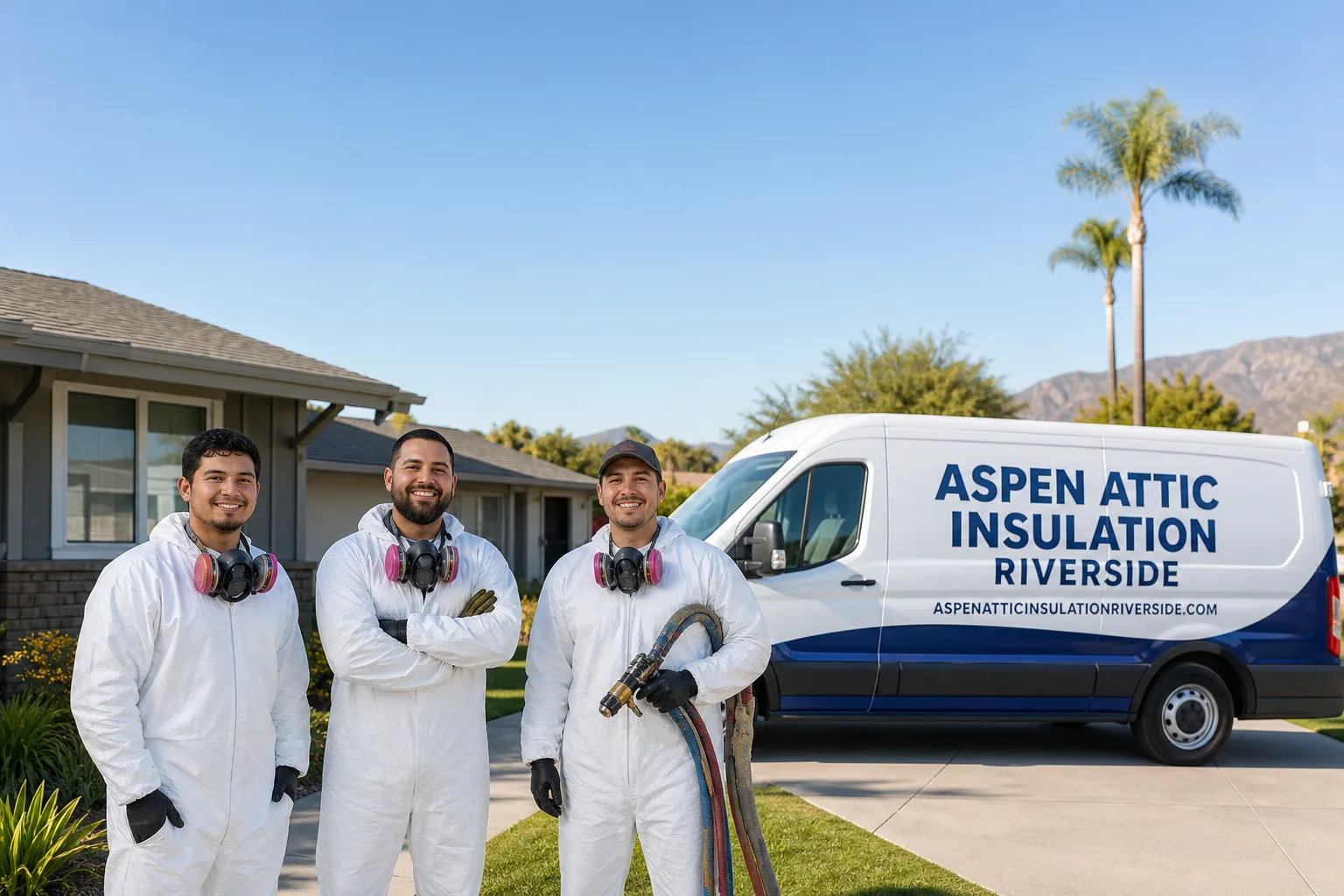
Fast, Reliable Blown In Insulation Across San Jacinto
Blown in insulation in San Jacinto typically costs $1.50 to $3.50 per square foot installed, depending on depth, existing insulation condition, and attic access. Most attic retrofits in San Jacinto run $1,800 to $4,200 for a standard single-family home, and we can usually schedule crews within 3 to 5 business days. If your attic still has the original loose-fill from the 1970s or earlier, it has likely settled to less than half its intended depth. That means you are paying to cool air that escapes straight through the roof. Call (510) 896-3857 and we will send a technician whose name and photo you will have before they knock.
Why Aspen Attic Insulation Riverside Is San Jacinto’s Preferred Blown In Insulation Company
San Jacinto homeowners call us for one reason more than any other: we tell them exactly who is coming before the work starts. Every technician is background-checked, identity-verified, and arrives in a clean marked uniform with a photo ID badge at the door. You get the tech’s name and photo before the visit. If anyone else shows up, the visit is free and we make it right. That is the Threshold Standard, and it matters to people who are home alone or have young kids in the house.
We know San Jacinto’s housing stock because we work in it every week. Older ranches off Ramona Boulevard, newer tracts east of Sanderson, and the established neighborhoods around the college all present different attic conditions. What does not change is the written price you get before any work begins, and the 365-Day Done Right Promise covering labor and materials for a full year. If a repair fails within that year, we come back free.
Blown In Fiberglass Insulation in San Jacinto
Blown In Fiberglass Insulation in San Jacinto is loose fiberglass blown into the attic cavity to fill every gap, seam, and corner that rolled batts leave exposed. In a city where summer temperatures routinely pass 100°F, the difference between an R-19 attic and an R-38 attic shows up directly on your cooling bill. We air-seal the top plates first, then blow to depth, typically using Owens Corning PROPINK or Johns Manville Climate Pro.
When It Makes Sense
Homeowners choose blown fiberglass when the existing attic insulation is thin, settled, or uneven. It is the most cost-effective way to improve whole-home thermal performance in San Jacinto’s wood-frame ranches and two-story builds from the 1980s and 1990s. Expect to pay $1.50 to $2.50 per square foot for standard blown fiberglass at R-38 depth in an accessible attic.
How the Job Goes
We run a hose from our truck to the attic, position it through the access hatch, and blow the material evenly across the attic floor. For tight attic hatches common in older San Jacinto homes, we protect the opening and keep dust contained. Most jobs finish in half a day.
Loose Fill Insulation in San Jacinto
Loose Fill Insulation in San Jacinto means loose fibers or cellulose blown into an attic cavity to create a continuous thermal blanket without gaps or voids. When we find original loose-fill that has compacted to three or four inches, topping it up with fresh material is usually the fastest fix. Loose fill excels in the irregular attics of 1960s and 1970s San Jacinto homes, where framing and cross-members make batts nearly impossible to fit tightly.
Settled Insulation and Top-Ups
Original loose-fill in homes built before 1990 has often settled to half its original depth. That leaves effective coverage near R-9 or worse in attics that should be at R-38 or R-49. We can blow new material directly over the old after air-sealing, which saves you the cost and mess of a full removal.
Cellulose vs. Fiberglass Loose Fill
GreenFiber cellulose loose fill runs $1.75 to $3.00 per square foot in San Jacinto attics, depending on depth and access. Fiberglass loose fill runs slightly less. Both work well in this climate; the choice usually comes down to whether you prefer recycled content or a lower-dust installation.
Trusted Brands We Service in San Jacinto
We stock materials from Owens Corning, Johns Manville, and GreenFiber for San Jacinto jobs, matched to the specific attic condition rather than whatever happens to be on the truck. If you have an existing Owens Corning system and need a match, we can do that. Same for Johns Manville. We do not push a one-size-fits-all product. The material goes in according to what your attic actually needs, and the brand is named on your written quote before work starts.
Common Blown In Insulation Problems We See in San Jacinto Homes
- Settled original loose-fill in pre-1990 attics. Many downtown San Jacinto homes have loose-fill that has compacted to three to five inches, which triples summer cooling loads. The heat gain is invisible until someone actually climbs into the attic on a hot afternoon and feels the temperature difference.
- Knob-and-tube wiring in older downtown homes. Live knob-and-tube circuits must be routed and contained before insulation is blown around them. Burying live wires under new insulation creates a fire hazard, and we flag it during the attic inspection before any material goes in.
- Tight alley-load garages in newer developments. Many newer San Jacinto tracts have garage and attic access points that are cramped or partially blocked. That leads to skipped sections near the eaves, which is where the most heat enters in summer.
- Missing or inadequate attic access panels. Some older ranches never had a properly cut attic hatch. We see homeowners who have lived in a house for ten years without ever seeing their attic. That is the first thing we check on any blown in insulation estimate.
Pricing for Blown In Insulation in San Jacinto, CA
Blown in insulation in San Jacinto runs $1.50 to $3.50 per square foot installed, with most complete attic retrofits landing between $1,800 and $4,200 for a standard 1,200 to 1,800 square foot single-family home. Attic access difficulty, existing insulation removal, and whether air-sealing is included all move the number. A cramped attic hatch in an older downtown block will cost more in labor than a wide-open truss attic in a newer tract east of State Street. We give you a written price before any work starts, and that price does not change unless you add scope. Call (510) 896-3857 for a free estimate, and we will send the technician’s name and photo before the visit.
We Also Serve Cities Near San Jacinto
Beyond San Jacinto, our crews regularly work in Blown In Insulation across Moreno Valley, Perris, Mentone, and Lake Elsinore. If you are in a neighboring community and want the same written-price, named-technician approach, call (510) 896-3857 and we will get you on the schedule. For more detail on our San Jacinto service area, see Blown In Insulation in San Jacinto.
Serving San Jacinto, CA - Our Local Coverage Area
We’re based in the San Jacinto area and know this community well. Use the map below to see our service coverage - if you’re nearby, we can almost certainly help.
FAQs About Blown In Insulation in San Jacinto
Look for three signs: uneven indoor temperatures between rooms, a second floor or hallway that stays hot after 5 p.m. in summer, and insulation that measures under six inches deep across most of the attic floor. In San Jacinto’s older downtown neighborhoods, original loose-fill often settles to three or four inches, which means you are running an air conditioner against a barely-insulated ceiling. A quick attic measurement tells us what you have, and the estimate is free. Call (510) 896-3857.
Yes, but only after the wiring is properly routed and shielded so the insulation does not bury live conductors. We inspect for exposed knob-and-tube, and if we find active circuits, we contain them before any material is blown. Burying live wiring under insulation is a fire risk and a code violation, and we will not do it. If you suspect knob-and-tube in your attic, call us for an inspection before you schedule any insulation work.
Spring and early fall give the most moderate attic temperatures for crews, but the best time is before the first serious heat wave. Many San Jacinto homeowners wait until July, when the upstairs hallway is already unbearable, and then compete for the same scheduling window. If you book in April or May, you are insulated before the 100°F days hit. We schedule year-round, including same-week appointments for urgent cases.
The best window is spring, between March and early May, before the San Jacinto Valley’s peak summer heat arrives. Attics are still cool enough for crews to work efficiently, and you get the full benefit of the insulation before the first 100°F stretch. Early fall works too. Midsummer is possible but slower, since attics over 120°F limit how long a crew can safely stay inside. Call (510) 896-3857 to check current scheduling.
In most San Jacinto homes you can blow new insulation directly over the old settled material after we air-seal the top plates and check for wiring issues. Exceptions include rodent contamination, water damage, or mold, which require removal first. A standard top-up costs less than a full removal and gets you to R-38 or R-49 in a single pass. We will tell you during the attic inspection which path your house needs.
Blown in insulation slows conductive and convective heat transfer through the ceiling, while radiant barrier reflects radiant heat from the underside of the roof deck. In San Jacinto’s hot, dry summers, they work best together: blown insulation at R-38 to R-49, plus a radiant barrier under the rafters to reflect the direct solar load. We install both, and the combination is the standard we recommend for homes where upstairs rooms stay hot after sunset. Call (510) 896-3857 for an exact quote.
If your San Jacinto attic still has the original insulation from when the house was built, you are paying for it every month. We send a named, photo-badged technician, put the price in writing before work begins, and back the job with the 365-Day Done Right Promise. Call (510) 896-3857 and talk to a live person, day or night, to schedule your free attic assessment.
Written by Garrett Sloane, Owner at Aspen Attic Insulation Riverside, serving San Jacinto and the surrounding Inland Empire since 2002.