
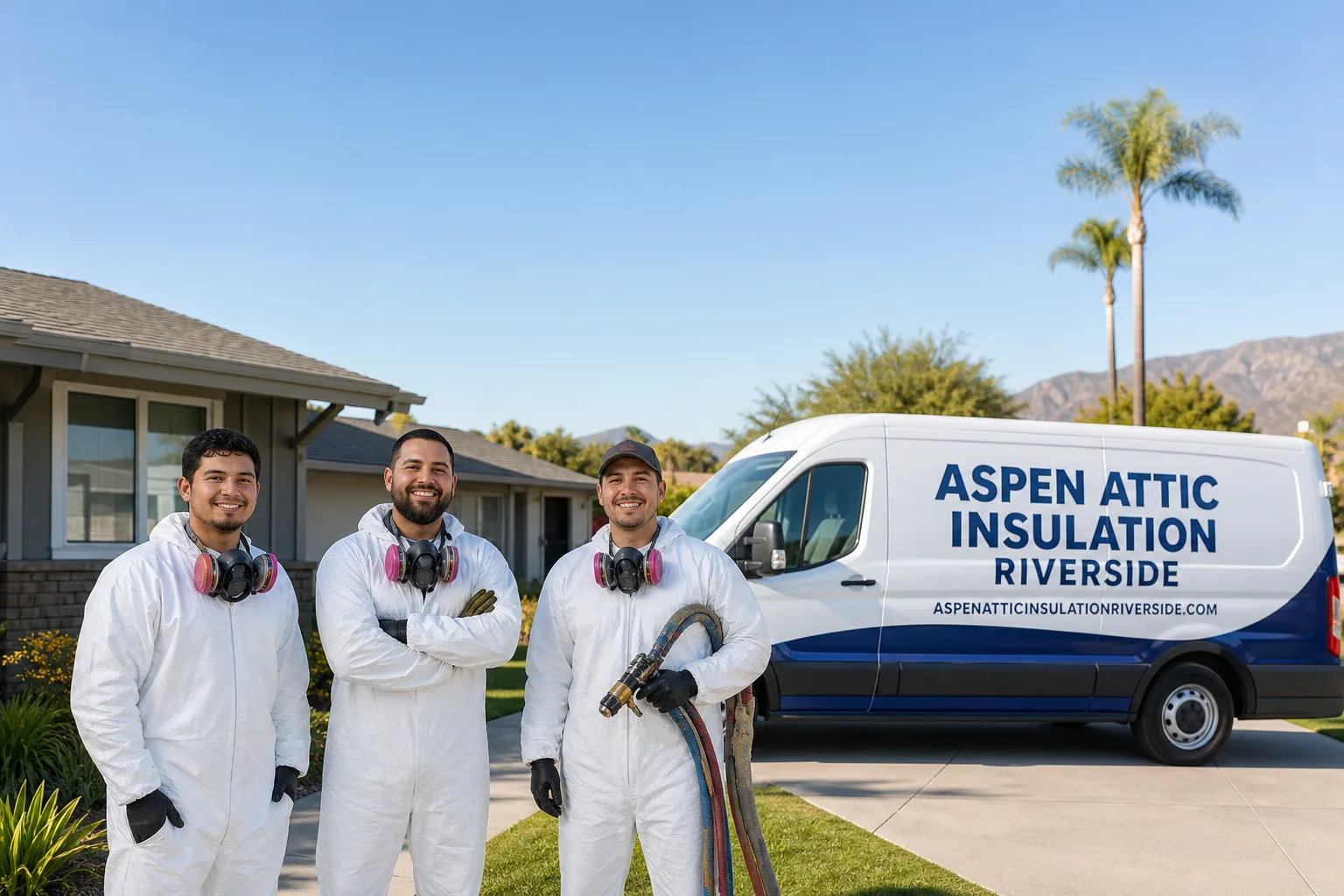
Fast, Reliable Spray Foam Insulation Across Moreno Valley
Spray foam insulation in Moreno Valley typically costs $2.50 to $6.50 per board foot installed, with most attic projects landing between $4,800 and $11,500 depending on square footage and foam type. Our crews reach most Moreno Valley neighborhoods the same day you call, and we carry open-cell and closed-cell foam on every truck so we’re not making you wait for materials. Call (510) 896-3857 for a written estimate before any work starts. No surprise line items. No vague ballparks. A real person answers, any hour.
Why Aspen Attic Insulation Riverside Is Moreno Valley’s Preferred Spray Foam Insulation Company
Moreno Valley homeowners know the drill by now. August hits, the upstairs bedrooms bake, the AC runs nonstop, and the electric bill climbs past four hundred dollars. The root cause in most of these homes is an attic that never got the insulation it needed, or got insulation that gave up years ago. Our Spray Foam Insulation team has crawled through hundreds of these attics between Moreno Beach Drive, Sunnymead Ranch, and the neighborhoods climbing toward Box Springs Mountain. We know the framing styles, the truss spacing, the original venting setups, and where the air leaks hide.
Every technician who knocks on your door in Moreno Valley is background-checked, identity-verified, and photo-badged. You get the tech’s name and photo before the visit, which matters when someone is coming into your home. If anyone else shows up, the visit is free and we make it right. That’s the Threshold Standard, and we’ve held every Moreno Valley job to it since day one.
Garrett Sloane leads this operation with one standing rule: written price before any work starts, and a 365-day Done Right Promise behind every job. If the foam doesn’t perform, we return and correct it. Free second visit, in writing, covering labor and materials for a full year.
Open Cell Spray Foam in Moreno Valley
Open Cell Spray Foam in Moreno Valley is the workhorse for most of the tract homes built between 1980 and 2005. This foam expands on contact, fills the cavity, and creates an air seal that fiberglass batts can’t touch. Applied to the underside of the roof deck or along the attic floor, it stops the convection loops that pull 110-degree outside air into the house and leak conditioned air out. The first sentence that matters to a Moreno Valley homeowner is this: open-cell foam is the fastest way to stop the thermal bleeding in a hot attic.
A typical open-cell installation in a 1,800 to 2,400 square foot Moreno Valley home runs $5,200 to $9,800, depending on coverage area and depth. We typically install at R-38 to R-49 in attic assemblies, which meets and usually exceeds what the original builder-grade batt ever delivered.
What the Job Involves
We start by mapping the attic with an infrared camera. That shows us exactly where the old fiberglass has slumped, where the top plates are bleeding heat, and where unsealed penetrations are drafting. Then we air-seal the bypasses before foam touches anything. Foam over an unsealed attic is wasted money.
When Moreno Valley Homeowners Choose Open Cell
Open-cell works best on ventilated attics where the roof deck stays accessible and the homeowner wants to cut both heat gain and noise. It is also the right choice when old batts have settled under R-11 and need to come out first. In Moreno Valley’s dry climate, open-cell holds its shape well once cured, with no settling and no compaction over time.
Spray Foam Insulation Contractors in Moreno Valley
Spray Foam Insulation Contractors in Moreno Valley are not all built the same, and the difference shows up in the details. We see jobs where crews sprayed foam over a dirty, dusty attic floor and called it done. The foam peeled within two seasons. We see jobs where nobody sealed the old can lights first, so hot air kept pouring through the recessed housings. We see jobs where ventilated attics got closed-cell foam against the roof deck without a vapor strategy, and the underside of the plywood went musty by the following winter.
Our crew in Moreno Valley runs a different protocol. Every job starts with a written scope and a fixed price. The tech arrives in a clean marked uniform, shows a photo ID badge at the door, and walks you through exactly what will happen before any equipment comes off the truck. Garrett Sloane’s name is on the estimate, and his phone number is on it too.
Retrofit Versus Replacement Decisions
Many Moreno Valley homeowners call us assuming they need a full attic overhaul. Sometimes they do, but often the fix is narrower. We assess the existing insulation, the venting, and the air-leak map before recommending anything. Open-cell foam applied along the attic floor after air sealing fixes most of these attics for under seven thousand dollars.
Infrared Verification After the Job
We don’t ask you to take our word for it. Once the foam cures, we run a second infrared scan and show you the before-and-after. You’ll see the top plates gone cold, the temperature gradient flattened, and the old hot spots erased. That’s the proof, and it’s specific to the house you live in, not a brochure.
Trusted Brands We Service in Moreno Valley
We stock and install foam from Owens Corning, Johns Manville, and Knauf, matched to the specific job rather than whatever happens to be on the truck. Moreno Valley customers get faster turnaround because we don’t order materials after the contract is signed. The foam is staged at our Inland Empire dispatch office and loaded for each Moreno Valley job the night before. That means a Monday estimate can be a Tuesday installation, weather permitting. No three-week lead times, no backorders, no substitution games.
Common Spray Foam Insulation Problems We See in Moreno Valley Homes
- Open-cell foam over a still-ventilated attic without a vapor check. Moreno Valley’s cool winter nights can drive moisture into the foam, and if the attic still breathes freely, condensation forms on the roof deck. We’ve pulled back foam in early 90s homes and found mildew. The fix is closing the attic properly or using a hybrid open-cell plus vapor barrier approach.
- Settled fiberglass batts under R-11 in east-side neighborhoods. Near Box Springs Mountain, we routinely scan attics where R-19 batts have compressed to under R-11. That’s more than half the original insulation value gone, and the homeowner never knew because nobody looked.
- Unsealed can lights and single-pane windows creating bypasses. In 1990s Moreno Valley homes, original recessed lights leak conditioned air all day and all night. Spray foam can’t fix a bypass it never touches. If we foam over an unsealed attic, the hot spots in upstairs bedrooms stay hot.
- Fiberglass dust and fibers migrating into living spaces. Older batts break down in Moreno Valley’s dry heat and fine particles drift down through ceiling penetrations. Homeowners with allergies notice it. Air-sealing the attic floor before foaming stops that migration completely.
Pricing for Spray Foam Insulation in Moreno Valley, CA
Open-cell spray foam in Moreno Valley runs $2.50 to $4.25 per board foot installed. Closed-cell runs $4.50 to $6.50 per board foot. A full attic air-seal plus open-cell on the floor typically lands between $5,200 and $9,800 for the tract homes that dominate this market. Roof deck applications run higher because the surface area is larger, usually $8,500 to $14,000 for a two-story stucco home. The variables are attic size, accessibility, how much old insulation needs removal, and whether the can lights must be sealed and capped first. Every estimate we give in Moreno Valley is written, fixed, and includes the 365-day Done Right Promise. Call (510) 896-3857 for your number.
We Also Serve Cities Near Moreno Valley
Our crews regularly run the 215 corridor and the 60 east. We handle Spray Foam Insulation in Moreno Valley alongside jobs in Perris, Riverside, Loma Linda, and Mentone. Same crews, same written-price rule, same 365-day guarantee. If you’re within twenty-five minutes of our Inland Empire dispatch, we can typically schedule you within two business days.
Serving Moreno Valley, CA - Our Local Coverage Area
We’re based in the Moreno Valley area and know this community well. Use the map below to see our service coverage - if you’re nearby, we can almost certainly help.
FAQs About Spray Foam Insulation in Moreno Valley
Spray foam air-seals the attic, and fiberglass batts only slow heat down. In Moreno Valley’s 1980s through 2000s tract homes, the original batts have typically settled to under R-11 in the hottest sections, so adding another layer on top doesn’t fix the air leaks and bypasses doing the real damage. Foam seals the gaps first, then insulates. Call (510) 896-3857 and we’ll show you your attic’s actual readings, not a textbook chart.
No, not in a ventilated attic. Moreno Valley’s cool winter nights drive moisture into the underside of the roof deck, and open-cell foam against a deck that still breathes outside air can trap that moisture against the plywood. The correct installation closes the attic ventilation and treats the space as conditioned, or uses a hybrid approach with a vapor strategy. We assess the existing venting before recommending a method, and we’ll walk you through exactly why on site.
In east-side neighborhoods near Box Springs Mountain, we regularly find R-19 batts that have slumped to under R-11 in the worst spots, with some sections measuring as low as R-7. That’s a 50 to 60 percent loss of the rated value. Our infrared scans document the delta, and after air-sealing and foaming, the same attics read a consistent R-38 or better across the entire plane. The difference shows up on the first hot week.
Usually yes, with one condition. Those large single-story attics have a lot of floor area, and the key is air-sealing the entire plane before foam goes down. If we seal the bypasses, cap the can lights, and apply open-cell over the sealed floor, the attic becomes a stable barrier and the home stops losing conditioned air. If we skip the sealing, the foam underperforms and the homeowner pays twice. We don’t skip it.
It does, once the attic floor is air-sealed first. Old fiberglass in Moreno Valley’s dry heat breaks down into fine fibers that migrate through ceiling penetrations and into the living space. Sealing those penetrations with foam stops the migration at the source, and the foam layer itself locks down any remaining loose material. Homeowners with allergies or asthma notice the improvement within days. For an exact assessment of your attic’s condition, call (510) 896-3857 and we’ll bring the infrared camera.
Written by Garrett Sloane, Owner at Aspen Attic Insulation Riverside, serving Moreno Valley since the early 2000s.